The omnichannel acquisition engine.
Why your store network is one of your most underutilised performance marketing assets – and how to change that.
Omnichannel shoppers have an average of 73% higher spend than non-omnichannel shoppers (Google/Kantar), and 68% of European consumers are channel agnostic, meaning they move freely between online and offline rather than committing to one (Google). That reality requires a convenient, frictionless experience, regardless of where they are in their journey.
Yet, the 2026 Omnichannel Index shows that most retailers are still running their digital marketing as if the store doesn’t exist. Not because the opportunity is hidden, but because the organisational structures, incentives, and data foundations needed to capture it haven’t been built.

Insights by:
Torje Ingebretsen
Omnichannel Retail Specialist
YOUR STORES ARE WORTH MORE THAN YOUR E-COM NUMBERS SHOW
I’ve spent 15 years at Google working in performance marketing, focused on large omni-retailers across Northern Europe. That means I sit at a unique intersection: I see how consumers search, how ads perform, and how those digital touchpoints connect to physical store sales.
One finding consistently surprises retailers when they first see it: Google as a channel influences more in-store revenue than it does e-commerce.
The intent is there. Consumers research digitally, then buy in-store. They check stock online before making the trip. They use Google to find what’s nearest, available, and worth visiting. In fact, 77% of consumers say they feel more confident in their purchase once they’ve done research (Google/Ipsos). Yet, only 28% of retailers use Google Inventory Shopping Ads in the Awareness phase. That means the vast majority are invisible at exactly the moment local purchase intent is highest.
The retailers who have connected these dots – building what we call an omnichannel acquisition engine across web, app, and store – are seeing a decisive competitive advantage. Their store networks become an active engine in performance marketing, and that is a structural advantage that pure e-commerce players simply cannot replicate.
For every $1 driven in online sales, Google channels generate an average of $1.60 in attributable in-store revenue. If you only optimise for the $1 online, you are leaving the $1.60 on the table.
FIX YOUR INCENTIVE STRUCTURE FIRST
Before any omnichannel marketing solution can work, internal teams need to be aligned around the right goal. I see this disconnect constantly: C-level leadership is measured on total sales across all channels, while digital marketing teams are measured on e-commerce revenue only. The KPIs never meet and the store gets left out of the performance equation entirely.
The index reflects this. The Purchase phase scores 53% – the highest of all five phases – because online purchase mechanics are broadly mature. Yet in-store purchase innovation remains very limited: Mobile POS is available in only 5% of stores, and cross-device basket persistence is absent in most. These are not technology problems. They are incentive problems. Nobody is being rewarded for solving them.
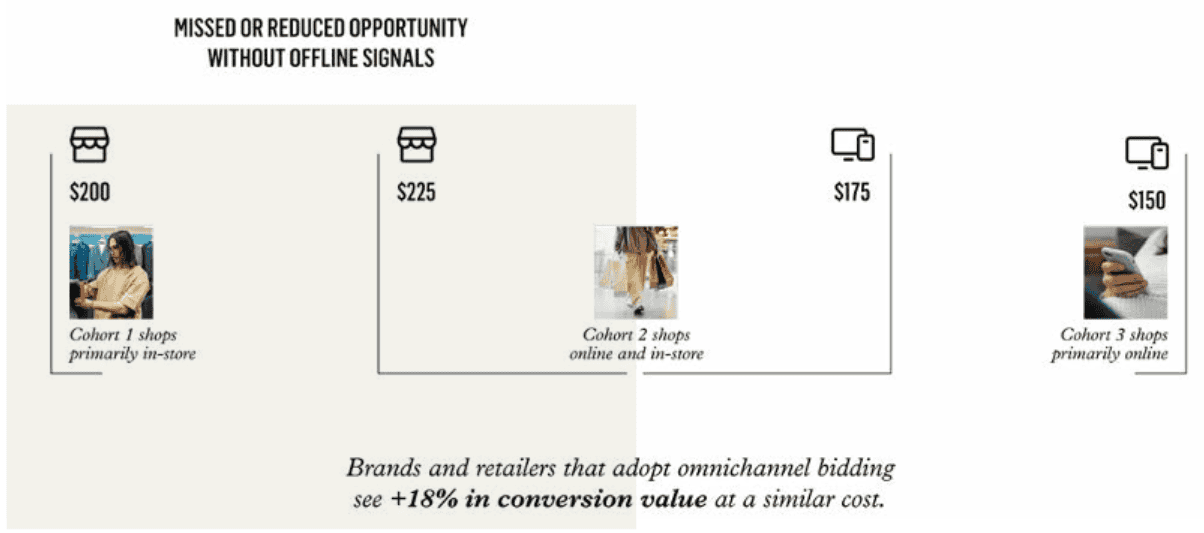
The fix is straightforward: define a single total sales KPI covering web, app, and store, eliminate internal competition between digital and physical, and ensure your agency is optimising to the same goal – not just e-commerce ROAS. Retailers who adopt omnichannel bidding see +18% in conversion value at a similar cost (Google). That’s what aligned incentives unlock.
START FEEDING OFFLINE SIGNALS INTO YOUR CAMPAIGNS
Once incentives are aligned, the next step is to make sure your campaigns are fully capitalising on local purchase intent. Google can track store visits that follow ad clicks – without the retailer sharing any proprietary data. You simply assign a value to what a store visit is worth to your business, and that signal feeds directly into campaign optimisation.
More importantly, connecting your point-ofsale data to Google Ads means that actual instore transactions flow back into your bidding strategy in real time. Your campaigns stop optimising for the $1 online and start optimising for the full $2.60.
It sounds basic – and it is. But a large number of retailers, including major ones, are still not using it. Only 5% offer Mobile POS in stores; even fewer are feeding those physical touchpoints back into digital optimisation. This is probably one of the lowest hanging fruits in performance marketing today.
AUTOMATION IS TABLE STAKES – DATA IS THE DIFFERENTIATOR
Machine learning and automation have fundamentally changed performance marketing. Manual, granular campaign management is no longer a path to growth. The AI optimises better, faster, and at a scale no team can match. That part is settled.
The real competitive question is: what data are you fuelling it with?
The retailer with richer first-party data wins more relevant impressions at better prices. Two data sources are critical:
Connecting loyalty and CRM data to campaigns means store sales feed directly into bid optimisation – a compounding advantage with every transaction. The catch: many retailers sit on large loyalty databases they legally cannot activate because consent infrastructure wasn’t built in from the start. Fix that first.
Local inventory, real-time availability, clickand-collect. These connect your ads to physical reality at the moment a consumer is deciding where to buy, letting you surface Pickup Today and Pickup Later options before a competitor does. Retailers who run Local Inventory Ads alongside Shopping ads see a 21% increase in store visits and a 9% increase in online conversions for products available in-store (Google).
Leading retailers take this one step further: a cross-channel attribution model spanning all digital channels, giving the CMO and digital teams a single source of truth for budget allocation. Decisions grounded in total sales, not channel-level ROAS. That alignment is rarer than it should be – and it’s exactly what separates retailers growing the top line from those optimising in circles.
BUILDING THE CAPABILITIES TO COMPETE
Getting the strategy right is one thing. Building the organisational capabilities to execute is another.
Retailers must embrace a predictive, test-andlearn approach to AI. Google is constantly evolving its ad formats and tools – and retailers need to move with that pace, not behind it. That means feeding high-quality inputs into AI-powered tools: strong landing pages, well-structured creative assets, and clearly defined business goals. The quality of what goes in determines the quality of what comes out.
It also means deepening the integration of AI marketing tools across the board. AI-powered campaigns – including AI Max for Search, Demand Gen, and Performance Max – are built to adapt to the non-linear ways consumers now discover and buy. Combined with generative creative tools, they allow brands to produce studio-quality work at scale and match ads dynamically to complex consumer intents. Marketers who deeply integrate these tools report 60% greater revenue growth than peers who don’t (Google, 2024).
The gap between retailers using AI and retailers competing with AI is widening. The difference is depth of integration.
THE OMNICHANNEL SHOPPER IS YOUR MOST VALUABLE CUSTOMER
68% of consumers are channel-agnostic, moving freely between online and offline depending on the moment. And these omnichannel shoppers spend 73% more than their single-channel counterparts (Google, 2024). The business case for seamless channel integration has never been stronger.
But winning those shoppers requires delivering on three things in the physical store:
- Convenience – making the journey frictionless at every step.
- Expertise – knowledgeable in-store associates remain a powerful conversion lever. Sales influenced by store staff carry a 194% higher average order value than those that aren’t.
- Experience – physical stores must be sensory, social, and worth the trip. Long queues and overcrowding are the fastest ways to undermine that expectation.
The store isn’t competing with digital. It’s completing it. The retailers who treat the physical experience as the culmination of a digitally-informed journey – not a separate channel – are the ones capturing the full value of that 73% spending premium.
THE CHECKLIST: WHAT TO PRIORITISE NEXT
In collaboration with Google, we assessed 373 brands across six markets, covering 74 customer-facing touchpoints and more than 27,000 data points in the Omnichannel Index 2026.
Explore the full report to see where retailers are leading, where gaps remain and what the strongest omnichannel performers are getting right.
READY TO UNLOCK YOUR OMNICHANNEL POTENTIAL?
Want to turn these insights into better marketing performance and growth? Reach out to Anders to explore what omnichannel acquisition could mean for your business.


