Everyone's talking about AI. But are brands using it to create real customer value?
Why the most talked-about technology in commerce is also the lowest-scoring – and where the real gap between ambition and execution lies.
AI dominates every commerce conference keynote, every earnings call, every strategy deck. It is, without question, the most discussed topic in e-commerce right now. It is also the lowest-scoring category in this year’s Omnichannel Index. Across 373 brands and five AI-related questions, only 19% of possible scores came back positive.
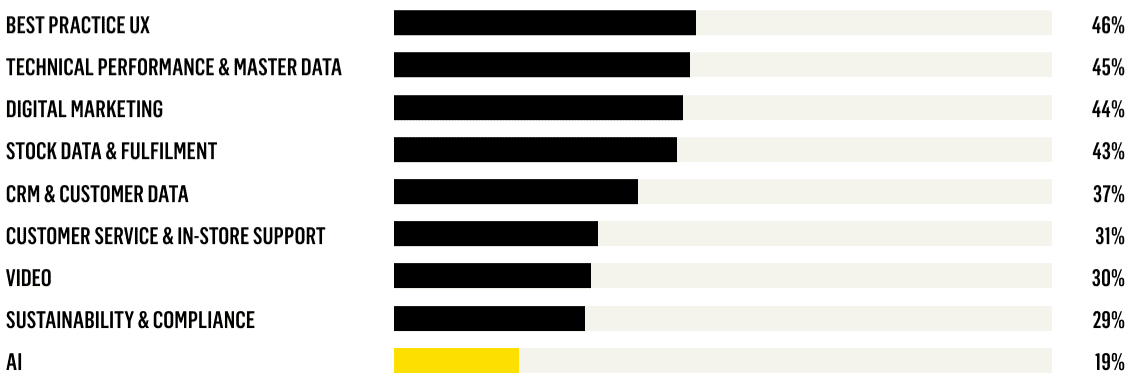
For context: Best Practice UX scores 46%. Technical Performance sits at 45%. Even Video manages 30%. AI trails every single category, and it isn’t close. This article isn’t about what AI could do. It’s about what brands are actually doing with it – and where the gap between ambition and execution is widest.
A NEW RECIPIENT
For two decades, “responsive design” has meant adapting the same content for different screens. Desktop to mobile to tablet. The layout changed, but the recipient was always the same: a human being browsing with their eyes and deciding with their gut.
That’s no longer the full picture. A new type of recipient is arriving on your pages – AI agents that browse, parse, and represent your products on behalf of consumers. They don’t scroll. They don’t hover. They don’t read hero images. They read structure, extract attributes, and make judgments about relevance based on how well your content is organised for machine consumption.
And this isn’t a future scenario. It’s already happening through AI-powered shopping assistants, comparison tools, and recommendation engines that scrape and interpret product pages. To measure how prepared brands are for this shift, we assessed whether key pages – PDPs, PLPs, and editorial content – are structured in a way that AI agents can reliably parse and represent.
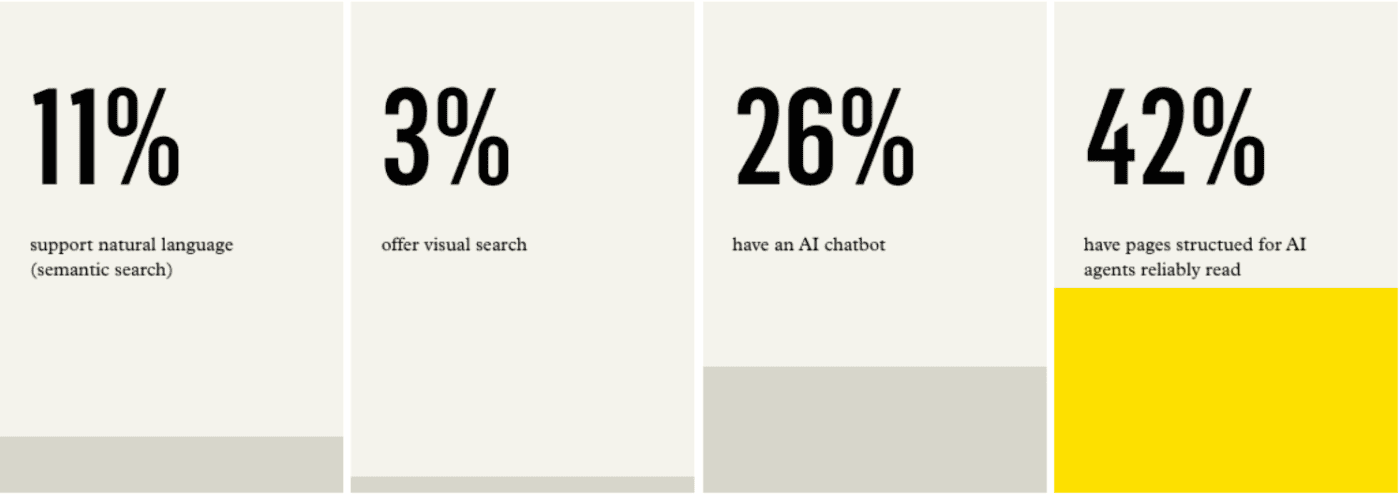
Only 42% of brands scored positively.
What’s emerging is a fundamentally different recipient, with its own behavioural patterns and expectations. It demands deliberate design consideration alongside (not instead of) the human experience.
WHAT AGENTS LEAVE BEHIND
The arrival of AI agents isn’t just a technical concern. It changes the stakes for every human interaction your brand has.
Agents don’t replace your site. They don’t make filters or product grids obsolete. What they absorb are tasks – the boring, repetitive, high-confidence decisions where the customer already knows what they want and just needs execution. Rebooking a hotel. Reordering contact lenses. Comparing energy prices. Finding the cheapest flight on specific dates. These are errands, and agents are built to handle them.
What they leave behind is everything that requires judgment, taste, or trust. The customer who doesn’t know which running shoe fits their gait. The one choosing between three sofas who needs to feel confident about the fabric. The one with sensitive skin trying to find a moisturiser that won’t react.
These people still show up on your site. But they’re not there to browse a grid and apply filters. They’re there because the decision is hard enough that they don’t trust an agent to make it for them. That makes them fewer, more intentional, and carrying higher expectations than anything in the browse-and-buy era.
So now you have two problems. A new recipient that needs machine-readable content. And a remaining human audience that expects more from every interaction, precisely because the easy stuff has been delegated away.
Where the human experience is failing
Traditional search forces customers to express themselves on the engine’s terms, including guessing the right keyword, the right product tag, the right category name. Semantic search flips that. It lets the customer describe what they actually want – “lightweight summer jacket that doesn’t wrinkle” – and the engine figures out what they mean. 11% of brands offer this. The rest still make the customer do the translating. Visual search – uploading a photo of what you want – sits at 3%. That’s twelve brands out of 373.
These aren’t feature gaps on a checklist. They’re failed interactions with a customer who showed up expecting to be understood and who had every option to delegate this errand to an agent instead.
Conversational shopping is the missing sales associate. 26% of brands have deployed an AI chatbot. That’s the highest score among the five AI questions, and it’s easy to see why: chatbots deflect support tickets and reduce cost-to-serve. But only 13% offer anything resembling conversational shopping – an AI that acts as a guided sales associate, helping the customer navigate the catalog based on their actual needs.
The category data sharpens this. Beauty & Pharmacy – a category where product selection is deeply personal, dependent on skin type, sensitivities, and individual preferences – scores 3% on conversational shopping. Department Stores and Hypermarkets, with the broadest catalogues and the most overwhelming browsing experiences, score 0%. Not one brand out of 25 offers guided AI shopping.
These are the categories where a human customer most needs help making a decision. And they’re the categories most absent from the one AI application that directly serves that need.

THE COST-CENTRE TELL
The gap between chatbot adoption and conversational shopping reveals where brands see AI’s value: as a cost-reduction tool, not a revenue driver. The highest-scoring AI feature is one that deflects support tickets. The lowest-scoring is the one that acts as a sales associate.
That priority is backwards if agents are about to absorb the easy tasks anyway. The utilitarian interactions brands are racing to automate with chatbots are the same ones agents will handle on the customer’s behalf. What remains – the hard decisions, the high-consideration purchases, the moments where someone genuinely needs guidance – demands the investment brands aren’t making.
Brands are spending on AI that answers the questions agents will soon handle. They’re underinvesting in AI that helps with the decisions only a human would show up to make.
WHERE THIS LEAVES YOU
The pressure is coming from both directions. A new recipient is arriving that needs structured, machine-readable content. And the human customers who remain are showing up with higher expectations, precisely because the routine has been delegated away.
19% says most brands aren’t there on either side.
The starting point is deciding which one matters most to you right now: making your content ready for the agents already parsing your pages, or making the human experience worth showing up for.
Both require the same thing: a clear view of where AI fits into your customer experience – from the data and automation layer underneath to the brand safety, tone of voice, and personalisation strategy on top. The question is whether you have that layer in place to serve both recipients.
READY FOR THE NEXT ERA OF AGENTIC COMMERCE?
The brands that win won’t just be visible to AI agents – they’ll be ready to transact with them. Here’s how we help you get there:
See your brand the way AI agents do. Identify gaps, fix blind spots, benchmark against competitors.
Define your highest-value agentic use cases, quantify the impact, and build a 12–24 month plan your organisation can act on.
Assess whether your platform can support agent-initiated transactions and map out exactly what it takes to get there.
In collaboration with Google, we assessed 373 brands across six markets, covering 74 customer-facing touchpoints and more than 27,000 data points in the Omnichannel Index 2026.
Explore the full report to see where retailers are leading, where gaps remain and what the strongest omnichannel performers are getting right.
Want to talk agentic commerce?
If you want to nerd out about what the next era of agentic commerce means for your business with an actual human (not an AI) Ask is your guy. He’s spent years at the intersection of data, martech and commerce architecture – and he’s always up for a good conversation about where this is all heading.
